


Hello, SLART here, and welcome to Weekly Art Practice, AKA Projekt Rattloch.
Grant application news
I’ve had some good news this week in terms of grant applications. I have got through to the next round in Unlimited, the grant for a sculpture project. I mentioned this a couple of weeks ago. The idea is to have a sculpture in a sculpture park in East Anglia.
My idea was a “sculpturisation”, which isn’t even a real word, but I like using it, of my piece “Time, the Great Equaliser”. It’s an hourglass with a baby at one end and a skeleton dripping into a grave at the other end. I want to make it into a sculpture, and part of that is fabrication. That basically means getting someone who’s an expert in steel, or whatever material we use (to be honest, I don’t know), to help create the sculpture for me from my idea. I know it’s all very Damien Hirst, getting someone else to do your work, but I’m excited about it.
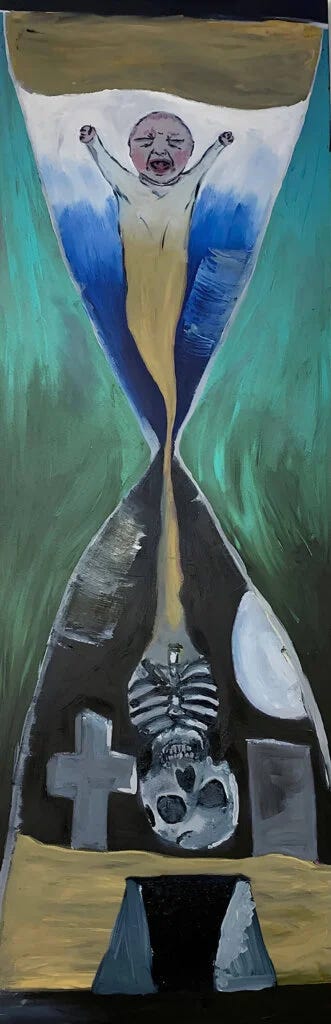
They sent an acknowledgement that my application has been successful in the first round. The way it works is you apply for the projects, and then it’s decided by the committee whether it’s put forward. So I’m chuffed about that. I’ll keep you posted, of course, and see what happens. No, let’s think positive, I’m going to get the grant, there we are.
Artsy and Studio BRUT
Another thing going on this week: I have a lot of ideas, as you know, but I wanted to see if I can get an Artsy account. I know they’re not the gods of selling art or anything, but I think it does build a certain credibility for artists, and you can’t normally get on it unless you’re a gallery.
So what I wanted to do is register Studio BRUT as an organisation, and then go through the funding or application route to get an account on Artsy. That would in turn allow Studio BRUT’s artists to sell their work on Artsy. I think that kind of credibility boost is going to help anyone, but outsiders especially, to feel that sense of credibility. Not that you need it; you can say “fuck it” to credibility. But it’s just an idea that I’m pursuing.
It costs, I can’t remember exactly, I’m sure it’s about £800 a month, which is quite a lot. But if I get, say, 50 artists on there, it’s supporting them and getting Studio BRUT out there on the Artsy scene. Pretty cool. What do you think? Has anyone got experience of Artsy on here? I did see a post the other day about an artist on Substack who got accepted to Artsy. I can’t remember his name, but I’ll see if I can find that post and get in touch with him to check it out.
Update: here it is, congrats Wade!
Supporting Jacksta Art
I’ve been supporting my artist friend, Jaskta Art, with uploading his YouTube videos, which has been quite cool. I’ve also been helping set up his Shopify account, so he’s got some nice framed pictures on there. It’s a print-on-demand service called Printumo. You put your artwork on there and they handle the fulfilment. Someone buys from you, you pay them, say, £50 out of that, and then you keep the rest of the money from the customer.
I’ve been exploring that for my own art as well, but it’s taken a back seat because I’ve got so many plates spinning. We’ll see how it goes with Jaksta. He said he wanted to put my art on there as well, which was really nice of him. I might put a couple of pieces on there, and you never know, he might grow it into having a few local artists on there. We’ll see how that goes.
Drawing and the secret project
I’ve still been drawing. For this secret project, I’ve set a plan of sorts where I draw seven drawings on a Monday lunchtime, email them to myself, and they get uploaded to the website. I’m not going to share it yet; I’m going to keep you hanging. I don’t know what I’m waiting for. Maybe I will just share it, but I kind of want to see it be successful before sharing, because it feels like it’s just another spontaneous SLART idea. Maybe next week I’ll change my mind, share it with you and see what you think. Watch this space.
Museum therapy AKA ‘museotherapy’
I also wanted to share this. My dear friend Beth Raps, who’s a fantastic coach, sent me this “museotherapy” concept, along with an accompanying Substack post, “Art, Memory, and Structured Encounters”, which I’m going to link below, well above now. It’s about the difference between clinical art therapy and using museum space as a kind of therapy. Beth was saying that in places like France they do prescribe going to museums, which I need to check out. It definitely does help, I think. You often get peace of mind from going around art galleries; they’re generally quite peaceful spaces. I’ll talk about it briefly, but you can read the post after.
The post is a conversation with Nicole Rademacher, a Los Angeles-based artist and clinician (an art therapist and licensed marriage and family therapist). She describes an event where participants could express themselves in whatever way they wished, and it was all fluid and open. But as she is a professional practitioner based in America, she explains that there are different criteria for being a therapist (Than the UK). Clinical art therapy is more structured and has more of a support framework around it. Museum therapy is more about the experience, and there isn’t any follow-up. So if you went to a museum and it triggered something, there’s no follow-up to that. I think the article explains it a lot better than me, but I found the concept really interesting.

It links into the exploration I’ve been doing around Robert Irwin, who inspired me to make the cube space that I had at the BRUT opening. That’s now expanding into an ongoing installation where I experiment with the question: what does peace of mind feel like in a space? This has given me a new angle to work on. I’m going to start working on it again soon, taking the cube back into the studio after it’s been out in the gallery space.
YouTube Shorts
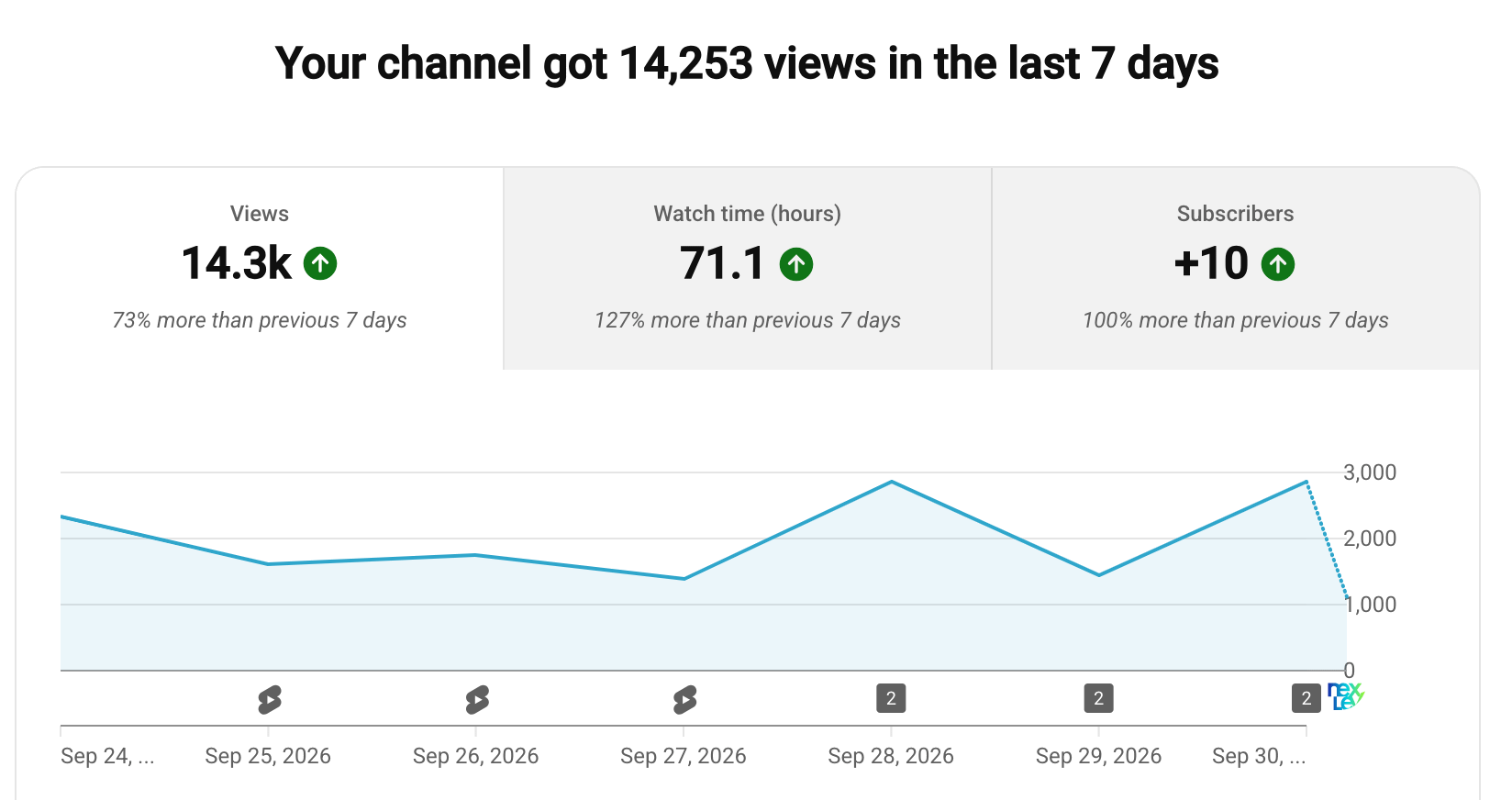
I’ve still been posting on YouTube Shorts, and I’ll put a little breakdown below. I haven’t had any massive outliers yet, but it’s been quite interesting and enjoyable to do. Any questions, please comment and I’ll get back to you.
So that’s me for now, over and out,
SLART.
P.S. Before you go Please subscribe to my YouTube Channel for a more audio visual flavour of SLART.
Thank you for including International Museotherapy Initiative. I’m Minette, the founder.
To clarify, there is follow up—that’s the impetus of having an art therapist involved. They have the knowledge and skills to ease the transition. Many museums have started consulting with art therapists when hosting sensitive shows, as well.
We’re so happy to see this work gaining interest and are here to answer any questions.
SLART, thank you for the shoutout! and I like your thought about the risk of no follow-up if one gets triggered in a healing experience in a museum. Good point! I've always found museums and galleries to be such healing spaces that it never occurred to me there could be a downside to museum therapy. This approach used in Brussels seems to address that, though: https://www.brussels.be/museum-prescriptions That is a description of how it works from the City of Brussels itself.
This article is more engaging and detailed: https://www.thebulletin.be/brussels-expands-its-successful-museum-prescriptions-programme-beyond-mental-health-patients Nathalie Bondil is someone to watch in this space, she's mentioned in this article: https://theconversation.com/museums-on-prescription-how-cultural-activities-are-becoming-crucial-to-the-public-health-debate-291083 which tells me that New York's MoMA was one of the first to do this...I didn't know that!
I LOVE the piece you've chosen to make into a sculpture. I've always loved that piece and it will work beautifully in three dimensions. (Four?) And you cracked me: "very Damien Hirst." I am chuffed right along with you.
PS: I am suitably enjoying hanging (re: your secret art project).